Under Article 14 of the Data Retention Directive the Commission must produce a public evaluation of the application of the Directive before 15 September 2010. A draft version of that document has now been leaked (along with the Irish Government’s submission) and makes for very interesting reading.
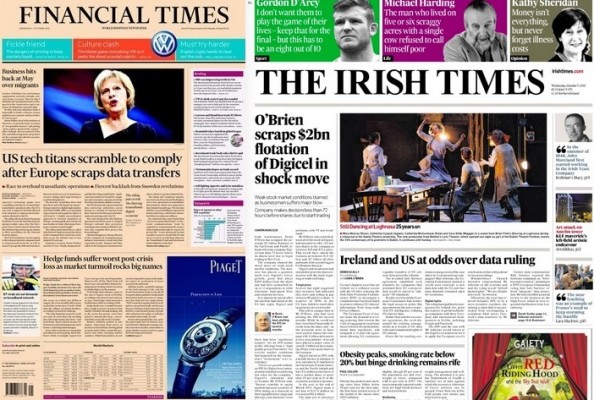
Karlin Lillington has an excellent summary in today’s Irish Times, and here are some of the highlights:
Ireland is one of the countries accessing private information the most:
THE GARDA made more requests for phone-call traffic data in 2008 than police in Germany, which has 20 times the population of the Republic.
According to a leaked draft of a European Commission report, gardaí made more than 14,000 access requests for call data in 2008, a rate about 40 per cent higher than had been previously assumed by data privacy advocates, who had based an estimate of 10,000 on figures provided in the past by gardaí to the Office of the Data Protection Commissioner.
Older data is very seldom accessed:
According to the report, the vast majority of data requests across the EU – 85 per cent – are made when the data is less than seven months old, with the bulk of requests, 70 per cent, filed for data held for less than three months.
Statistics gathered from member states “support the conclusion that the relevance of data decreases significantly” with age, the report says.
The report found no concrete evidence from any state to support longer retention periods. “No objective elements were found that could support the choice of the retention period: neither the prevalence of certain forms of crime, the geography of the [member state], or (in-)efficiencies of a law enforcement organisation seem to support the choice,” it says.
The report shows there are very few requests within any state, including Ireland, for data after 12 months. Only 109 requests in aggregate from eight EU countries including Ireland were made in 2008 for mobile data held longer than 18 months. Only 39 total requests from the same eight countries were made for fixed-line call data stored longer than 18 months.
Fears of function creep have been borne out, and data retention is being used for matters such as filesharing cases:
It also notes that many member states have implemented the EU data retention directive by widening its scope and retaining data that was not retained in the past, often allowing it to be used for more purposes than outlined in the directive, such as for civil litigation on copyright in the UK. Such expansion is referred to as “mission creep” by privacy advocates.
Irish companies will be at a competitive disadvantage due to data retention:
The report says some respondents feel that in states with lengthy retention periods, private industry is at a competitive disadvantage because of the burden and costs that retention may impose directly or indirectly.
Several network operators said the need to invest in retention infrastructure had caused them to delay or abandon improvements to national networks.
Deutsche Telekom claimed it had spent €5.2 million on implementation of retention infrastructure and €3.7 million a year to facilitate about 13,000 call data requests and 6,500 internet data requests. Other operators said they had spent in excess of €4 million setting up systems for providing access to stored data.
As predicted, prepay SIM cards have made data retention measures ineffective and have led to Member States – including Ireland – attempting to ban their use:
In the Government’s response to a questionnaire on the State’s implementation of data retention, the Department of Justice noted it was considering ways to identify users of pre-paid SIM cards, an issue which was raised by several states.
In addition to these points, the full document is full of more damning details. For example, not one Member State provided any statistical information demonstrating that data retention was of use in any significant number of cases (p.7), while it’s clear from responses that the Directive – which was sold as a harmonisation measure – has completely failed to achieve this (p.8). Similarly, national data protection authorities have pointed out that they often lack proper powers to supervise data retention and that telecommunications companies often lack proper security over customer data (pp.9-10).
May 14th, 2010
After last week’s excitement, this week is something of an anti-climax – when the case came back before the High Court today the State applied for and were granted further time to consider the judgment. The case will be listed next on June 11th.
May 12th, 2010
Great news today from the High Court where Mr. Justice McKechnie gave an extremely favourable decision on our constitutional challenge to data retention laws.
While the full judgment is 53 pages long, the gist is relatively simple.
Long story short: today’s decision has cleared the way for our challenge to proceed and to challenge the entire European legal basis for data retention.
(Following the wider European trend where Germany, Bulgaria and Romania have all found aspects of data retention to be unconstitutional.)
The longer version: Today’s decision dealt with three procedural issues which had to be cleared before we can argue the substance of the case: i.e. whether mass surveillance of this sort is compatible with constitutional guarantees of fundamental rights.
The first of these issues dealt with standing: could DRI (as a company, not a natural person) assert rights of privacy? And could it argue the rights of privacy of others? On this point the court held in our favour, accepting that DRI was a “sincere and serious litigant”, which raised these issues with bona fide interest and concern and ruling that it was appropriate for us to argue these points as this was a matter of “fundamental public importance”.
The second point dealt with an attempt by the State to stop the action in its tracks by seeking “security for costs” – i.e. requiring us to make a payment into court to cover the costs of the State should we lose the action. Because of the cost of High Court actions, requiring such a payment at the outset could effectively have prevented the case from being heard. Here the court rejected the State’s application, holding that:
the matters pleaded in this case do raise issues of significant public importance… Given the rapid advance of current technology it is of great importance to define the legitimate legal limits of modern surveillance techniques used by governments… without sufficient legal safeguards the potential for abuse and unwaranted invasion of privacy is obvious… That is not to say that this is the case here, but the potential is in my opinion so great that a greater scrutiny of the proposed legislation is certainly merited.”
Finally, the third point related to our application to refer this case to the European Court of Justice (“ECJ”). As data retention is now dealt with at a European level, it is important that we be able to challenge the European law in this area – something which can only be done before the ECJ in Luxembourg. Here the court again accepted our argument, holding that a reference to the ECJ was required and that it was appropriate that it be made at the current stage of the proceedings.
So what happens next? There will be some more legal argument next week about the precise questions which should be referred to the ECJ – after that, the case will be referred to the ECJ and will go into their system for a hearing in Luxembourg, which have implications for data retention across Europe.
May 5th, 2010
Karlin Lillington writes in today’s Irish Times about the German decision striking down data retention law as a breach of privacy and what it means for the Data Retention Bill currently before the Oireachtas. Here’s an excerpt:
ANALYSIS: Data retention proposals about to become law here have been declared an invasion of privacy in Germany. Government please take note
IF THE Government fails to reconsider the terms of its Data Retention Bill, currently in its final stages before the Houses of the Oireachtas, it is likely to find that costly court challenges and a forced reworking of the legislation lie ahead.
The Retention of Data Bill 2009 seeks the overdue implementation of an EU directive on data retention (storage of call data for two years and internet-use data for one year, for everyone in the country, including children). It is the tail-end of a long process in which the right to privacy has been pitted against the needs of law enforcement to have access to records for criminal investigations.
Even as the Bill passed a Dáil vote that cements in its current provisions, there are signs that all is not well on the European front for national data retention legislation.
On Tuesday, in a significant finding, the German constitutional court threw out Germany’s existing data retention laws for a range of reasons, many of which have direct application to Ireland.
The German court echoed precisely the concerns expressed by many groups and individuals here about our own legislation – worries that were given a lone voice in the Dáil debate by Labour TD Seán Sherlock.
The German court found that enacting any data retention legislation requires a regard for what it termed the exceptional intensity of the interference with human rights that result from such measures. It therefore obligates the government to have clear and transparent measures in place to ensure data safety, data use, and adequate legal remedy available to citizens for misuse of personal data.
It said retention legislation must set a very high standard for safety of all data, and this cannot be balanced against a general burden of cost, whoever that may lie with. It underlined that access to data should only be allowed in cases targeting most serious crimes and terrorist offences. It argued that individuals must be notified after the fact that their information was accessed for an inquiry.
All of these issues have been highlighted as a concern in Ireland, where the Government has tried to downgrade the level of the crimes that our legislation applies to; does not outline a quality of service that must be met to protect data; does not cover the costs of managing and protecting data, but passes them on to the internet and telecoms sector; and does not give adequate legal remedy to citizens nor adequate oversight. Irish legislation would not meet the provisions laid out by the German court.
Privacy advocacy group Digital Rights Ireland has already brought a constitutional case against the Government in the High Court on the constitutionality of Irish legislation. This is widely expected to be referred to the European Court of Human Rights and prove a test case on the issue for the EU as a whole, where the German case will signal issues likely to prove troublesome for Irish and other EU nations’ retention laws.
Full text.
March 4th, 2010
The civil rights organisation which brought the successful challenge to data retention before the German Constitutional Court has now issued a press release on that decision. Here’s the full text:
Press release by the German Working Group on Data Retention (AK Vorrat)
2 March 2010:
After data retention ruling: Civil liberties activists call for political end to retention of telecommunications data
+++ Data retention opposed by 70% of German population +++ European
Citizens’ Initiative for repealing the EU directive on data retention announced +++ Legal action to be continued +++
The German Working Group on Data Retention has today announced a Europe-wide campaign to end Internet and telephone data retention. This follows the German Constitutional Court’s ruling on a mass complaint made by more than 34,000 citizens. According to a newly-published poll, 69.3% of all Germans oppose data retention, making it the most strongly rejected surveillance law.[1]
“The recording of confidential contacts and movements of the entire population in the absence of any suspicion is unacceptable and must stop immediately”, says Florian Altherr of the Working Group. “In starting an initiative to this end, the Federal Minister of Justice can count on the support of EU Commissioner Viviane Reding as well as of many states such as Austria, Belgium and Romania, all of which do not have data retention laws in place.”
“In order to bring the massive rejection of blanket data retention home to politicians we are in the process of preparing a European Citizens’
Initiative. With the signatures of one million opponents to the permanent logging of our Internet and phone use we want to pursuade the EU to repeal its data retention directive”, announces data protection activist padeluun of the Working Group.
Patrick Breyer of the Group adds: “At the same time we will continue our legal fight against data retention. Today’s decision proclaiming the recording of the entire population’s behaviour in the absence of any suspicion compatible with our fundamental rights is unacceptable and opens the gates to a surveillance state.”
The German Working Group on Data Retention is making five political demands after today’s ruling:
1. The Federal Government, the Federal Minister of Justice and Parliaments must now cooperate with other like-minded states and bodies to take steps to repeal the redundant and detrimental data retention directive.
2. The German law on data retention, going far even beyond EU requirements and – according to the German Constitutional Court – unconstitutional, must not be re-enacted.
3. European citizens should be given the right to file constitutional complaints directly with the European Court of Justice.
4. The Federal Government must not agree to any further collection of information on citizens not suspected of any wrong-doing in the name of security, such as the air travellers file proposed by the EU. Mass data pools that were introduced in the past, such as the registration of Internet use by the Federal Office for Information Security or the employee information system ELENA, must be closed down.
5. An independent review of all existing “security” measures must take place in order to systematically examine their compatibility with our fundamental rights, their effectiveness, their cost, their harmful side-effects and alternatives.
Background information:
Communications data enables the tracing of who has contacted whom via telephone, mobile phone or e-mail. In the case of mobile calls or text messages via mobile phone, the user’s location is also logged. Data retention allows citizens’ movements to be traced and personal and business contacts to be monitored. Information regarding the content of communications such as personal interests and individual life circumstances can also be deduced.
A study commissioned in 2008 shows that data retention is acting as a serious deterrent to the use of telephones, mobile phones, e-mail and Internet. The survey conduced by research institute Forsa found that with communications data retention in place, one in two Germans would refrain from contacting a marriage counsellor, a psychotherapist or a drug abuse counsellor by telephone, mobile phone or e-mail if they needed their help. One in thirteen people said they had refrained from using telephone, mobile phone or e-mail at least once because of data retention, which extrapolates to 6.5 mio. Germans in total.
German NGO Working Group on Data Retention (Arbeitskreis
Vorratsdatenspeicherung) organised several protest marches against the scheme. Last year, 20.000 people protested against surveillance in Berlin.[2] About Arbeitskreis Vorratsdatenspeicherung (German Working Group on Data
Retention):
The Arbeitskreis Vorratsdatenspeicherung (AK Vorrat) is a Germany-wide organisation which campaigns against extensive surveillance in general and the blanket logging of telecommunications and other behavioural data in particular.
Homepage and contact details: http://www.vorratsdatenspeicherung.de
Footnotes and Links:
[1] Poll on data retention (in German):
http://www.vorratsdatenspeicherung.de/images/infas-umfrage.pdf
[2] Protest march “Freedom not Fear”:
http://www.vorratsdatenspeicherung.de/content/view/333/79/lang,en/
About Arbeitskreis Vorratsdatenspeicherung (German Working Group on Data Retention):
The Arbeitskreis Vorratsdatenspeicherung (AK Vorrat) is a Germany-wide organisation which campaigns against extensive surveillance in general and the blanket logging of telecommunications and other behavioural data in particular.
Homepage und contact details: http://www.vorratsdatenspeicherung.de
March 3rd, 2010
Great news from Germany, where the Federal Constitutional Court has found data retention law to be incompatible with the right to privacy under the German Constitution. More thoughts on the decision and the implications for our own case at a later stage, but for the meantime here’s the initial AP report:
MELISSA EDDY Associated Press Writer
5:23 AM EST, March 2, 2010
BERLIN (AP) — Germany’s highest court on Tuesday overturned a law allowing authorities to retain data on telephone calls and e-mail traffic for help in tracking criminal networks.
A law ordering data on calls and e-mail exchanges be retained for six months for possible use by criminal authorities violated Germans’ constitutional right to private correspondence and must be revised, the Federal Constitutional Court ruled.
In its ruling, the court said the law failed to sufficiently balance the need for personal privacy against that for providing security, although it did not rule out data retention in principle.
“The disputed instructions neither provided a sufficient level of data security, nor sufficiently limited the possible uses of the data,” the court said.
Nearly 35,000 Germans had appealed to the court to overturn the law, which stems from a 2006 European Union anti-terrorism directive requiring telecommunications companies to retain phone data and Internet logs for a minimum of six months in case they are needed for criminal investigations.
The court upheld the EU directive, saying the problem lay instead with how the German parliament chose to interpret it.
Under the German law, which went into effect Jan. 2008, information about all calls from mobile or landline phones was retained for six months, including who called whom, from where and for how long.
The following year, that law was expanded to include the data surrounding all contact via e-mail.
Although the laws forbid authorities from retaining the contents of either form of communication, they met with fierce opposition from civil rights groups.
“Massive amounts of data about German citizens who pose no threat and are not suspects is being retained,” Germany’s commissioner for data security issues, Peter Schaar, told ARD’s morning show.
Experts argue the information is crucial to being able to trace crimes involving heavy use of the Internet, including tracking terror networks and pursuing child pornography.
March 2nd, 2010
Last month the Romanian Constitutional Court issued an important decision holding that national data retention laws were unconstitutional and in breach of the European Convention on Human Rights. The full text of that judgment is now available in English and makes cheering reading for civil liberties advocates, with the Constitutional Court accepting the argument that data retention is a disproportionate intrusion into private lives which is open to abuse. In the words of the Court:
[Data retention] equally addresses all the law subjects, regardless of whether they have committed penal crimes or not or whether they are the subject of a penal investigation or not, which is likely to overturn the presumption of innocence and to transform a priori all users of electronic communication services or public communication networks into people susceptible of committing terrorism crimes or other serious crimes.
November 26th, 2009
The Data Retention Bill goes to Committee Stage before the Dáil today. The Irish Council for Civil Liberties have put together some excellent submissions on how the Bill should be amended to protect fundamental rights – a copy is here.
Séan Sherlock (Lab.) is also on top of this issue and has put forward extremely desirable amendments designed to reduce the retention period and to establish greater transparency in the oversight of data retention – these are available on the Oireachtas website (PDF).
November 11th, 2009
From an email by Bogdan Manolea:
The Romanian Constitutional Court declared, yesterday afternoon, the data retention law (law 298/2008) as unconstitutional, as it breaches art 28 of the Romanian Constitution which provides that secrecy of the letters, telegrams and other postal communications, of telephone conversations, and of any other legal means of communication is inviolable.
So far there is no press release of the Court and the decision has not been published yet, there are only press articles about it. An English report (not entirely accurate) is available on mediafax.
As with the German decisions against data retention, this isn’t directly applicable to our High Court challenge. But it is extremely useful as evidence of a growing trend throughout Europe to find data retention laws constitutionally suspect.
October 9th, 2009
Karlin Lillington has a strong piece in today’s Irish Times about a leaked draft agreement on data retention between state agencies (the Garda Síochána, Revenue and Defence Forces) and the telecoms industry (represented by ALTO, TIF and the ISPAI). Her comments are worth quoting extensively:
A secret memorandum of understanding between State agencies and the communications industry on how to implement the as-yet non-existent Government data retention legislation, confirms longstanding concerns about who is managing the data retention agenda and to what end.
With data retention, it appears that the tail is wagging the dog, in blatant disregard for proper democratic legislative process. The agencies that want access to our call and internet data are bypassing the Oireachtas, which at least theoretically, is the body that draws up and implements legislation.
As one alarmed privacy advocate told me: “This is legislation by decree.” …
No doubt, the argument will be made – and indeed is, within the body of the 13 page memorandum – that the document exists to help streamline the process by which our data are requested and handed over to various bodies that will now be allowed to look at it. Or as the memorandum states: “to promote efficient and effective standards of co-operation between the State and the Communications Industry.”
But it is not the business of the agencies to arrange any such matters privately with the communications industry, especially in the absence of actual legislation, or any public discussion or input, or any significant Oireachtas debate on a Bill that has only recently been published and not yet debated.
A data retention bill has not been passed by the Oireachtas yet, so this extraordinary “agreement” is based on sweeping assumptions, not articles of law.
More startling is the fact that agencies and industry are making such secretive plans for co-operation at all. It is the job of the Oireachtas and, ultimately, the courts to determine how legislation will be interpreted and implemented, not the Garda Commissioner, the Revenue Commissioners or the Defence Forces by private agreement.
This is the equivalent of the Financial Regulator securing a private understanding with Irish companies and banks as to how they will be supervised and how evidence will be obtained from them for investigations.
Another concern is that the memorandum, as it stands, indicates an agreement to obtain data that goes beyond what has been proposed so far in the published data retention bill.
The memorandum arranges for communications companies to hand over ‘‘any available personal details” of an IP address user, e-mail sender or VoIP user, even though the draft Bill (as seen by The Irish Times earlier this year) only requires name and address.
The memorandum also contains an agreement to hand over the MAC address associated with a computer user – the numerical “address” of a physical piece of hardware, such as a laptop, that enables it to connect to a network – though not required by the Bill.
The memorandum concludes with supreme arrogance: a detailed schedule pertaining to what will be handed over and how, matched to the text from the “Act” – again, simply the proposed Bill the Oireachtas has not yet approved. The schedule has a column for the “mutual agreement of retained data” and another for “issues addressed and agreed”.
Excuse me? Since when do agencies and industry get to “mutually agree” how they will privately interpret and comply with publicly mandated legislation (setting aside the glaring absence of any such legislation on which to base their ‘mutual agreement’)?
The memorandum notes in conclusion that it should be disseminated within Government “where necessary” and copies of the signed agreement be filed with legal representatives and stored internally in company files.
So, we have a private deal arranged in advance, in disregard of the role of the democratically elected Oireachtas and with no public input or scrutiny, between State agencies and the communications industry on how they will interpret and act on one of the most controversial pieces of legislation proposed for the State and European Union.
Legislation that has massive privacy and security implications for citizens and for businesses, and which already has been criticised by several leading business figures from indigenous and multinational companies as a threat to Ireland’s business environment.
Such arrangements have no place in a democracy and will surely alarm businesses that have chosen to base themselves in Ireland. Revelations that they exist will not instill confidence that privacy safeguards will be respected for citizens or businesses, nor dispel concerns that other murky off the record arrangements will be made along the way.
To be fair, there are portions of the draft agreement which are highly desirable. It aims to establish a single point of contact principle, which should minimise mistakes and abuse. It seeks to have state authorities digitally sign and encrypt any email requests for information. And it clarifies the appallingly vague technical language in the draft Data Retention Bill in a way which may make it workable.
But these safeguards should be built into the legislation itself, made mandatory and enforceable by judicial supervision. Instead, this agreement leaves them to an ad hoc arrangement between the State and the telecoms industry, and admits that it is merely “a non-binding statement of understanding or agreement [which] creates no legal obligations or commitments on the signing parties”. Moreover, it does so in secret, with no public input into the process. And, as Karlin points out, in some places it goes beyond what the draft legislation would require, and commits ISPs to handing over information without any legal obligation or permission to do so.
Read the full text of the leaked agreement here.
September 25th, 2009